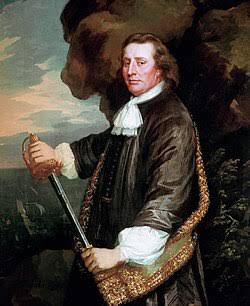
Myngs was born in Salthouse in what is now known as the Manor House and was baptised in St Nicholas Church in 1625. His mother was Katherine Parr and her family owned land in Salthouse as well as ships sailing from Salthouse and the Glaven ports.
Myngs already had a good deal of experience at sea sailing in the coastal trade on ships owned by his mother’s family when he joined the navy in 1648. He first appears prominently as captain of The Elizabeth, which after a sharp action during the first Anglo-Dutch wars, brought in a Dutch convoy with two ‘men of war’ as prizes. From 1653 to 1655 Myngs continued to command The Elizabeth. He was high in favour with the Council of State and was recommended for promotion by the flag officers under whom he served.
In 1655 Myngs was appointed to the frigate Marston Moor, the crew of which were on the verge of mutiny. He soon quelled the insubordinate spirit and he took the vessel out to the West Indies arriving in Jamaica in January 1656 where he became sub commander of the naval flotilla on the Jamaica Station, until the summer of 1657.
In February 1658 Myngs was appointed naval commander of Jamaica acting as a commerce raider during the Anglo-Spanish war. During these actions he acquired a reputation for unnecessary cruelty, sacking and massacring entire towns in command of fleets of buccaneers.
In 1658 after beating off a Spanish attack, he raided the coast of South-America. Whilst failing to capture a Spanish treasure fleet, he succeeded in destroying Tolu and Santa Maria in present day Columbia instead. In 1659 Myngs plundered Cumana, Puerto Cabello and Coro in present day Venezuela where a large haul of silver in twenty chests was seized.
The Spanish government considered Myngs a common pirate and a mass murderer, protesting to no avail to the English government of Oliver Cromwell about his conduct. However, because he had shared half of the bounty of his 1659 raid (about a quarter of a million pounds) with the buccaneers against the explicit orders of Edward D’Orley, the English Commander of Jamaica, he was arrested for embezzlement and sent back to England in The Marston Moor in 1660.
Despite his fall from grace the restoration government retained him in his command and in August 1662 he was sent to Jamaica again to command The Centurion and to resume his activities as commander of the Jamaica Station, but by this time the war with Spain had ended. This was part of a covert English policy to undermine the Spanish dominion in the area, by destroying as much as possible of the infrastructure.
In 1662 Myngs decided that the best way to accomplish this policy was to employ the full potential of the buccaneers by promising them the opportunity of unbridled plunder and rapine. Myngs enjoyed the full support of the new Governor, Lord Windsor, who fired a large contingent of soldiers and filled Myngs ranks with disgruntled men. That year Myngs attacked Santiago de Cuba and succeeded in taking and sacking the town despite its strong defences.
In 1663 buccaneers from all over the Caribbean joined Myngs for his next expedition. This consisted of Myngs directing the largest buccaneer fleet yet. It was fourteen ships strong with over 1400 pirates aboard. Among them were the privateers Henry Morgan and Abraham Blauvelt. In February they sacked San Francisco de Campeche but during the attack Myngs was severely wounded and left Edward Mansvelt in charge of his pirate army.
In 1664 Myngs returned to England to recouperate. In 1665 he was made Vice-Admiral in Prince Rupert’s squadron. As Vice-Admiral of the White under the Lord High Admiral James Stuart, Duke of York and Albany, he flew the flag during the second Anglo-Dutch war at the battle of Lowestoft in 1665, and for his share of the action received a Knighthood.
During the same year Myngs served under Edward Montagu, First Earl of Sandwich, as Vice-Admiral of the Blue and then, following the disgrace of Montagu, under the supreme fleet commander, George Monck, First Duke of Albermarle.
On 11 June 1666, whilst on detachment with Prince Rupert’s Green Squadron, the great four day battle began, but Myngs was able to return to the main fleet in time to take part on the final day. In this action his flotilla was surrounded by that of Vice-Admiral Johan de Liefde and Myngs was wounded. Firstly he sustained a cheek wound. Subsquently, he was shot in the left shoulder by musket balls fired by a sharp shooter when his ship Victory was challenged by De-Liefde’s flagship, The Ridderschap van Holland. Myngs died of his injuries shortly after returning to London. He was buried at St Marys Whitechapel three days later.